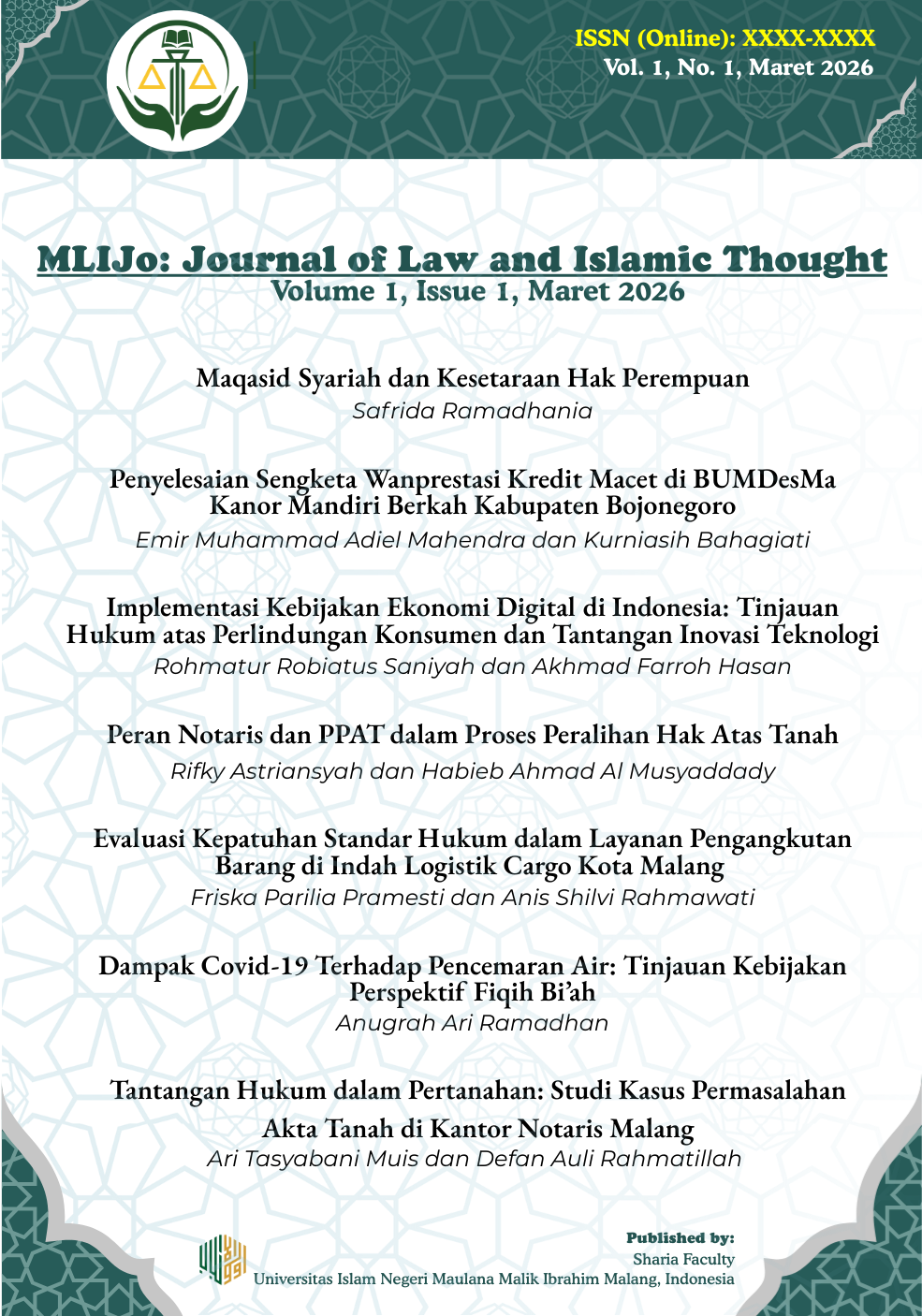
Dampak Covid-19 Terhadap Pencemaran Air Tinjauan Kebijakan Perspektif Fiqih Bi’ah
DOI:
https://doi.org/10.18860/mlijo.v1i1.4740Keywords:
Environmental Law; Fiqih Bi’ah; Islamic Environmental Jurisprudence; Water pollution.Abstract
Since its emergence in early 2020, the Covid-19 pandemic has brought significant global impacts not only on public health and the economy but also on environmental sustainability. One major issue is water pollution, which worsened due to the increase in medical and domestic waste generated during the pandemic. Hospitals and healthcare facilities produced tons of infectious medical waste daily, yet only a small portion possessed proper treatment permits and facilities. Consequently, much of this waste posed serious risks to water quality and aquatic ecosystems. On the other hand, restrictions on industrial and transportation activities temporarily reduced industrial waste discharge, improving water quality in certain regions. This study employs a normative legal research method using a statutory approach, analyzing primary and secondary legal materials, including Law No. 32 of 2009 and Government Regulation No. 82 of 2001, which govern environmental protection and water pollution control. The findings reveal that effective government oversight and law enforcement are essential to prevent environmental degradation. Furthermore, the study integrates the perspective of Fiqih Bi’ah (Islamic environmental jurisprudence) as a moral and spiritual solution. Grounded in the principles of kulliyat al-khamsah the preservation of religion, life, intellect, lineage, and property Fiqih Bi’ah emphasizes human responsibility as khalifah (steward) of the earth to maintain environmental balance. Integrating Islamic ecological ethics into environmental law and education can strengthen both legal and moral frameworks for sustainable water management in the post-pandemic era.
Downloads
References
Acim, S. A., & Suharti, S. (2023). The Concept of Fiqh al-Bi’ah in the Qur’an. Ulumuna, 27(1), 115–140. https://doi.org/https://doi.org/10.20414/ujis.v27i1.694
Amiruddin, M. M., Haq, I., Anwar, H., & Haris, A. (2024). Reforming Fiqh Al-Bi’ah (Ecological Jurisprudence) based on Islam Hadhari: An Integration Conservation Framework of Muamalah and Culture. International Journal of Law and Society, 3(3), 187–205. https://doi.org/10.59683/ijls.v3i3.99
Amirullah. (2022). Krisis Ekologi: Problematika Sains Modern. Lentera, 17(1), 1–21. https://doi.org/https://doi.org/10.21093/lj.v17i1.425
As’ari, K. (2023). Fiqh Bi’ah in Islamic and Character Education at Senior High School Levels: an Analytical Study on Kurikulum Merdeka). Emergent: Journal of Educational Discoveries and Lifelong Learning (EJEDL), 4(4), 174–184. https://doi.org/https://doi.org/10.17605/OSF.IO/79WSC
Bosse, K. R., Sayers, M. J., Shuchman, R. A., Lekki, J., & Tokars, R. (2021). Measuring the Impact of the COVID-19 Shutdown on Great Lakes Water Quality Using Remote Sensing. Frontiers in Marine Science, 8(August), 1–16. https://doi.org/10.3389/fmars.2021.673989
Citaningati, P. R., & Alfianto, T. (2024). Blue Economics in Islamic Economics Perspective: Fiqh Bi’ah Approach. Journal of Islamic Economic Laws, 7(02), 128–160. https://doi.org/10.23917/jisel.v7i02.5200
Darwis, D., & Siti, F. (2021). Hubungan Antara Pengetahuan dan Sikap Pelestarian Lingkungan dengan Perilaku Wisatawan dalam Menjaga Kebersihan Lingkungan. Jurnal Geografi, 4(1), 37–49. https://jurnal.unsil.ac.id/index.php/geografi/article/download/87/57
Departemen Agama Republik Indonesia. (2019). al-Qur’an dan Terjemahnya. In Kemenag RI (pp. 1–1281). Majma’ al-Malik Fahd li Thiba’ah al-Mushaf al-Syarif. https://dn790008.ca.archive.org/0/items/alqurandanterjemahnya/Al-Qur%27an dan Terjemahnya.pdf
Fad, M. F. (2021). Revitalization of Fiqh Al-Bi’ah in the Implementation of Green Banking for Islamic Bank. Journal of Islamic Economics Lariba, 7, 11–24. https://doi.org/10.20885/jielariba.vol7.iss1.art2
Fahmi, S. (2011). Asas Tanggung Jawab Negara Sebagai Dasar Pelaksanaan Perlindungan Dan Pengelolaan Lingkungan Hidup. Jurnal Hukum Ius Quia Iustum, 18(2), 212–228. https://doi.org/10.20885/iustum.vol18.iss2.art4
Hamdi, F., Ladraa, K., Benjammour, M., Hafidzi, A., & Ilhami, H. (2025). Integrating Maqashid al-Sharia, Fiqh al-Bi’ah, and Islamic Ethics for Sustainable Water Management: A Case Study of Indonesia. Al-Ahkam: Jurnal Ilmu Syari’ah Dan Hukum, 10(1), 1–19. https://doi.org/10.22515/alahkam.v10i1.11277
Ibrahim, S. (2022). The effects of COVID-19 on the water sector. Frontiers in Environmental Science, 10(November), 1–28. https://doi.org/10.3389/fenvs.2022.968703
Idrus, S., Husen, L. O., & Qamar, N. (2023). Penegakan Hukum terhadap Pencemaran Lingkungan Laut (Studi pada Kantor Syabandar Utama Makassar). Jurnal Pendidikan Tambusai, 7(2), 3750–3761. https://jptam.org/index.php/jptam/article/view/6275
Khuluq, M. K., & Asmuni, A. (2025). Hifz Al-Bi’ah as Part of Maqashid Al-Shari’ah and Its Relevance in the Context of Global Climate Change. Indonesian Journal of Interdisciplinary Islamic Studies, 7(2). https://doi.org/10.20885/ijiis.vol7.iss2.art3
Latifah, E. (2024). Fiqh al-Bī’ah and the Concept of Green and Blue Economy for Achieving Sustainable Development in the Context of SDGs. Invest Journal of Sharia & Economic Law, 4(1), 74–99. https://doi.org/10.21154/invest.v4i1.7732
Luczkiewicz, A., Pierpaoli, M., Szopińska, M., Baraniak, A., Kotlarska, E., Komiazyk, M., Remiszewska-Skwarek, A., & Fudala-Książek, S. (2025). Wastewater Quality During the Covid-19 Pandemic: a Retrospective Analysis of a Polish Case Study. International Journal of Environmental Science and Technology, 22(August), 4125–4142. https://doi.org/10.1007/s13762-024-05934-9
Manoiu, V. M., Wójcicka, K. K., Ioan Craciun, A., Akman, C., & Akman, E. (2022). Water Quality and Water Pollution in Time of Covid-19: Positive and Negative Repercussions. Water, 14(1124), 1–17. https://doi.org/https://doi.org/10.3390/w14071124
Nugroho, P., & Widiyanto, A. (2023). Ecology-Based Islamic Education: A Study of the Relationship between Islamic Education and Environmental Sustainability Efforts in the Cultural Traditions of Merti Dusun in Tetep Randuacir Salatiga. Proceeding International Conference on Religion, Science and Education 2, 543–551. https://sunankalijaga.org/prosiding/index.php/icrse/article/view/962
Nugroho, S. S., Haryani, A. T., & Farkhani, F. (2020). Metodologi Riset Hukum (Cetakan Pe). Oase Pustaka. https://unmermadiun.ac.id/repository_jurnal_penelitian/Sigit Sapto Nugroho/URL Buku Ajar/Buku Metodologi Riset Hukum.pdf
Raza, T., Shehzad, M., Abbas, M., Eash, N. S., Jatav, H. S., Sillanpaa, M., & Flynn, T. (2023). Impact Assessment of Covid-19 Global Pandemic on Water, Environment and Humans. Environmental Advances, 11(April), 1–15. https://doi.org/https://doi.org/10.1016/j.envadv.2022.100328
Raza, T., Shehzad, M., Qadir, M. F., Kareem, H. A., Eash, N. S., Sillanpaa, M., & Hakeem, K. R. (2022). Indirect Effects of Covid-19 on Water Quality. Water-Energy Nexus, 5, 29–38. https://doi.org/https://doi.org/10.1016/j.wen.2022.10.001
Peraturan Pemerintah Republik Indonesia Nomor 82, 1 (2001). https://ppkl.menlhk.go.id/website/filebox/830/191010121614PP NO 82 TH 2001 Tentang Pengelolaan Kualitas Air dan Pengendalian Pencemaran Air.pdf
Undang Undang Republik Indonesia Nomor 32, 1 (2009). https://jdih.esdm.go.id/common/dokumen-external/UU 32 Tahun 2009 (PPLH).pdf
Richey, R. C., & Kelin, J. D. (2010). Design and Development Reasearch. In Sustainability (Switzerland) (Vol. 11, Issue 1). Routledge Taylor & Francis Group. http://scioteca.caf.com/bitstream/handle/123456789/1091/RED2017-Eng-8ene.pdf?sequence=12&isAllowed=y%0Ahttp://dx.doi.org/10.1016/j.regsciurbeco.2008.06.005%0Ahttps://www.researchgate.net/publication/305320484_SISTEM_PEMBETUNGAN_TERPUSAT_STRATEGI_MELESTARI
Setyowati, R. D. N., Susilowati, F., Agung, T. S., & Sartika, E. R. D. (2021). Analisis Dampak Pandemi Covid-19 Terhadap Kualitas Udara Kota Surabaya. Orbith, 17(2), 165–171. https://doi.org/https://doi.org/10.32497/orbith.v17i2.2971
Solikin, N. (2021). Buku Pengantar Penelitian Hukum. Qiara Media. https://digilib.uinkhas.ac.id/12273/1/Buku Pengantar Metodologi Penelitian Hukum-Nur Solikin %281%29 %281%29.pdf
Suryani, A. S. (2020). Pembangunan Air Bersih dan Sanitasi saat Pandemi Covid-19. Aspirasi: Jurnal Masalah-Masalah Sosial, 11(2), 199–214. https://doi.org/10.46807/aspirasi.v11i2.1757
Wijaya, D. R., & Rangkuti, A. Z. (2025). Analysis of Illegal Sand Mining According to t he Syāfi ` I School of Fiqh ( Case Study of Hamlet III , Pertumbukan Village , Wampu District , Langkat Regency ). 15(02), 469–478. https://doi.org/10.58471/justi.v15i02
Yunus, A. P., Masago, Y., & Hijioka, Y. (2020). Covid-19 and Surface Water Quality: Improved Lake Water Quality During the Lockdown. Science of the Total Environment, 731(20 August), 1–8. https://doi.org/https://doi.org/10.1016/j.scitotenv.2020.139012