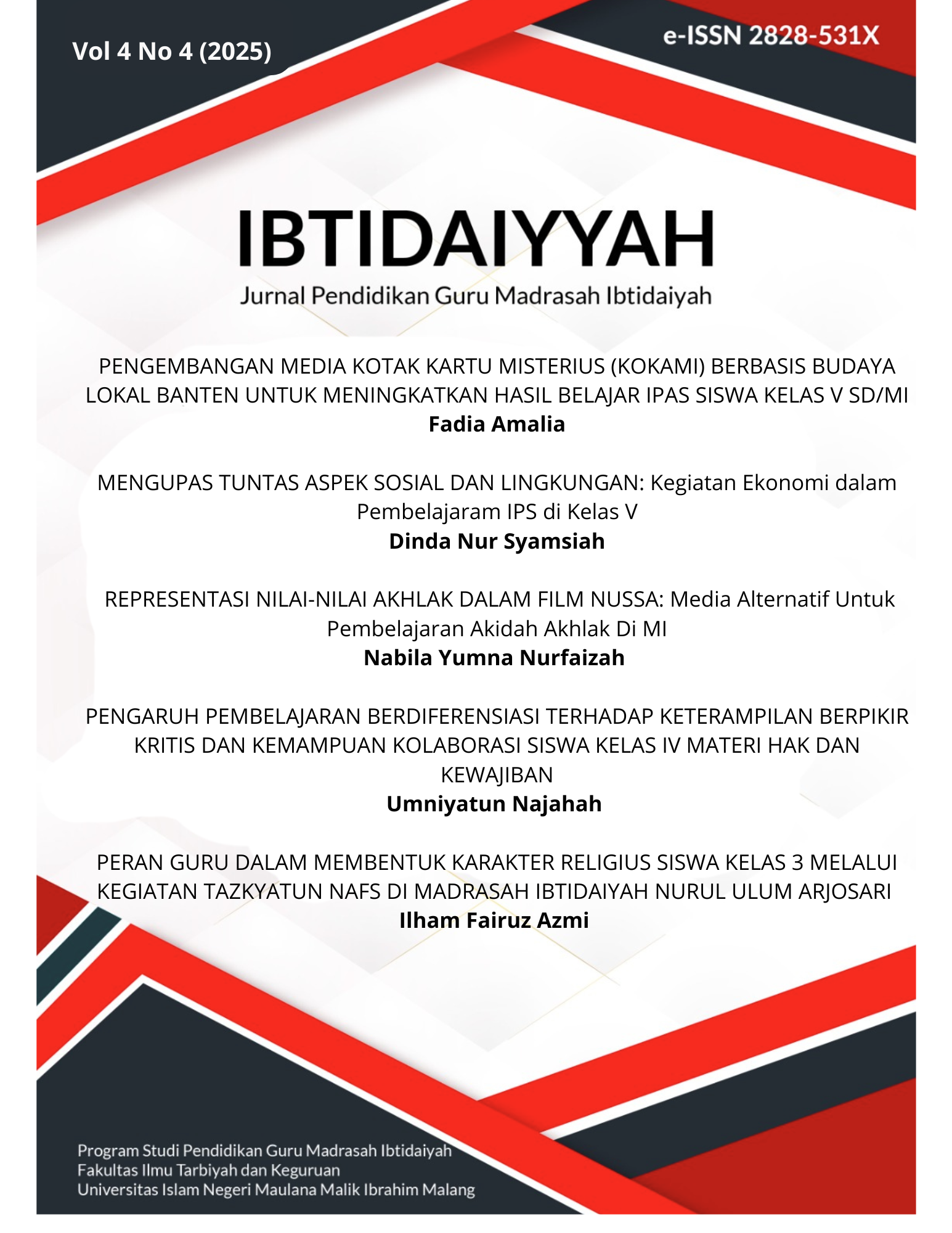
PENGARUH PEMBELAJARAN BERDIFERENSIASI TERHADAP KETERAMPILAN BERPIKIR KRITIS DAN KEMAMPUAN KOLABORASI SISWA KELAS IV MATERI HAK DAN KEWAJIBAN
DOI:
https://doi.org/10.18860/ijpgmi.v4i4.16006Keywords:
Pembelajaran Berdiferensiasi, Berpikir Kritis, KolaborasiAbstract
This study aims to determine the implementation of differentiated learning and its effect on the critical thinking skills and collaboration skills of fourth grade students in the Pancasila education subject on the material of rights and obligations. The study used a quantitative experimental approach with a One Group Pretest-Posttest Design. The subjects of the study were fourth grade students of SD Negeri 3 Madiredo. The instruments used were pretest and post-test questions to measure critical thinking skills and peer questionnaires to measure collaboration skills. The results of the study showed that the implementation of differentiated learning was in accordance with the syntax and principles of student-centered learning. In addition, differentiated learning has been shown to improve students' critical thinking skills by encouraging them to think actively, evaluate, and solve problems innovatively. This learning also improves students' collaboration skills, as demonstrated through active participation, effective communication, and increased responsibility and cooperation in groups. Thus, differentiated learning has proven effective in optimally stimulating students' critical thinking skills and collaboration skills.
ABSTRAK
Penelitian ini bertujuan untuk mengetahui pelaksanaan pembelajaran berdiferensiasi serta pengaruhnya terhadap keterampilan berpikir kritis dan kemampuan kolaborasi siswa kelas IV dalam mata pelajaran pendidikan pancasila materi hak dan kewajiban. Penelitian menggunakan pendekatan kuantitatif eksperimen dengan desain One Group Pretest-Posttest Design. Subjek penelitian adalah siswa kelas IV SD Negeri 3 Madiredo. Instrumen yang digunakan berupa soal pretest dan post-test untuk mengukur keterampilan berpikir kritis serta kuesioner sejawat untuk mengukur kemampuan kolaborasi. Hasil penelitian menunjukkan bahwa pelaksanaan pembelajaran berdiferensiasi telah sesuai dengan sintak dan prinsip pembelajaran yang berpusat pada siswa. Selain itu, pembelajaran berdiferensiasi terbukti meningkatkan keterampilan berpikir kritis siswa dengan mendorong mereka untuk berpikir aktif, mengevaluasi, dan menyelesaikan masalah secara inovatif. Pembelajaran ini juga meningkatkan kemampuan kolaborasi siswa, yang ditunjukkan melalui partisipasi aktif, komunikasi yang efektif, serta meningkatnya tanggung jawab dan kerja sama dalam kelompok. Dengan demikian, pembelajaran berdiferensiasi terbukti efektif dalam menstimulasi keterampilan berpikir kritis dan kemampuan kolaborasi siswa secara optimal.
Downloads
References
Afelia, Y. D., Utomo, A. P., & Sulistyaningsih, H. (2023). Implementasi Model Problem Based learning (PBL) Berbasis Pembelajaran Berdiferensiasi untuk Meningkatkan Keterampilan Kolaborasi pada Mata Pelajaran
Biologi di Kelas X SMA. Jurnal Biologi, 1(2), 1–11. https://doi.org/10.47134/biology.v1i2.1963
Dillenbourg, P. (1999). What do you mean by collaborative learning? Collaborative-learning: Cognitive and Computational Approaches. In Collaborative-learning: Cognitive and …. Elsevier.
Fisher, A. (2001). Critical Thinking: An Introduction. In Emotional Intelligence and Critical Thinking for Library Leaders. Cambridge University Press. https://doi.org/10.1108/978-1-78973-869-820201007
Greenstein, L. (2012). A Guide to Evaluating Mastery and Authentic learning. In Corwin (p. 243). Corwin Press.
Hasanah, M., Silangit, S. Z. P., Jamil, R. P., & Amanda, W. N. (2023). Analisis Tingkat Kemampuan Berpikir Kritis Siswa Sma Nurul Iman Tanjung Morawa. Pedagogi: Jurnal Ilmiah Pendidikan, 9(1), 16–22. https://doi.org/10.47662/pedagogi.v9i1.540
Irma Yuliantina, Kastanja, J., Damayanti, Y., Yunita, Jacob, A. M., Yani, F. I., Fitriani, Noviampura, F. H., Syoleha, I.,
Sucihati, M., & Haryanti, H. C. (2023). PKM Pembelajaran Berdiferensiasi bagi Anak Usia Dini Bersama IGTKI Kecamatan Pesanggrahan, Jakarta Selatan. Jurnal Pengabdian Masyarakat Formosa, 2(4), 229–238. https://doi.org/10.55927/jpmf.v2i4.5542
Johnson, E. B. (2002). Contextual teaching and learning: what it is and why it’s here to stay. In Choice Reviews Online (Vol. 40, Issue 02). Corwin Press, Inc. https://doi.org/10.5860/choice.40-1053
Noviyanti, N., Yuniarti, Y., & Lestari, T. (2023). Pengaruh Pembelajaran Berdiferensiasi Terhadap Kemampuan Computational Thinking Siswa Sekolah Dasar. Prima Magistra: Jurnal Ilmiah Kependidikan, 4(3), 283–293. https://doi.org/10.37478/jpm.v4i3.2806
Sugiyono. (2020). Metode Penelitian Kuantitatif, Kualitatif, dan R&D. Alfabeta.
Supranto, J. (2009). Statistik:Teori Dan Aplikasi. Erlangga.
Susanti, E., Alfiandra, A., Ramadhan, A. R., Nuriyani, R., Dameliza, O., & Sari, Y. K. (2023). Optimalisasi Pembelajaran Berdiferensiasi Konten dan Proses pada Perencanaan Pembelajaran PPKn. Educatio, 18(1), 143–153. https://doi.org/10.29408/edc.v18i1.14796
Tomlinson, C. A. (2000). Differentiation of Instructionin the Elementary Grades. ERIC Clearinghouse o n Elementary and Early Childhood Education.
Wibowo, A. M., Utaya, S., Wahjoedi, W., Zubaidah, S., Amin, S., & Prasad, R. R. (2024). Critical Thinking and Collaboration Skills on Environmental Awareness in Project-Based Science Learning. Jurnal Pendidikan IPA Indonesia, 13(1), 103–115. https://doi.org/10.15294/jpii.v13i1.48561
Ying-Hsui Liu, K. K., & LaShaune, J. P. (2017). Exploration of Factors in the Early Collaboration Phase Affecting Virtual Groups’ Overall Collaborative Learning Experiences. Journal of Educational Computing Research.