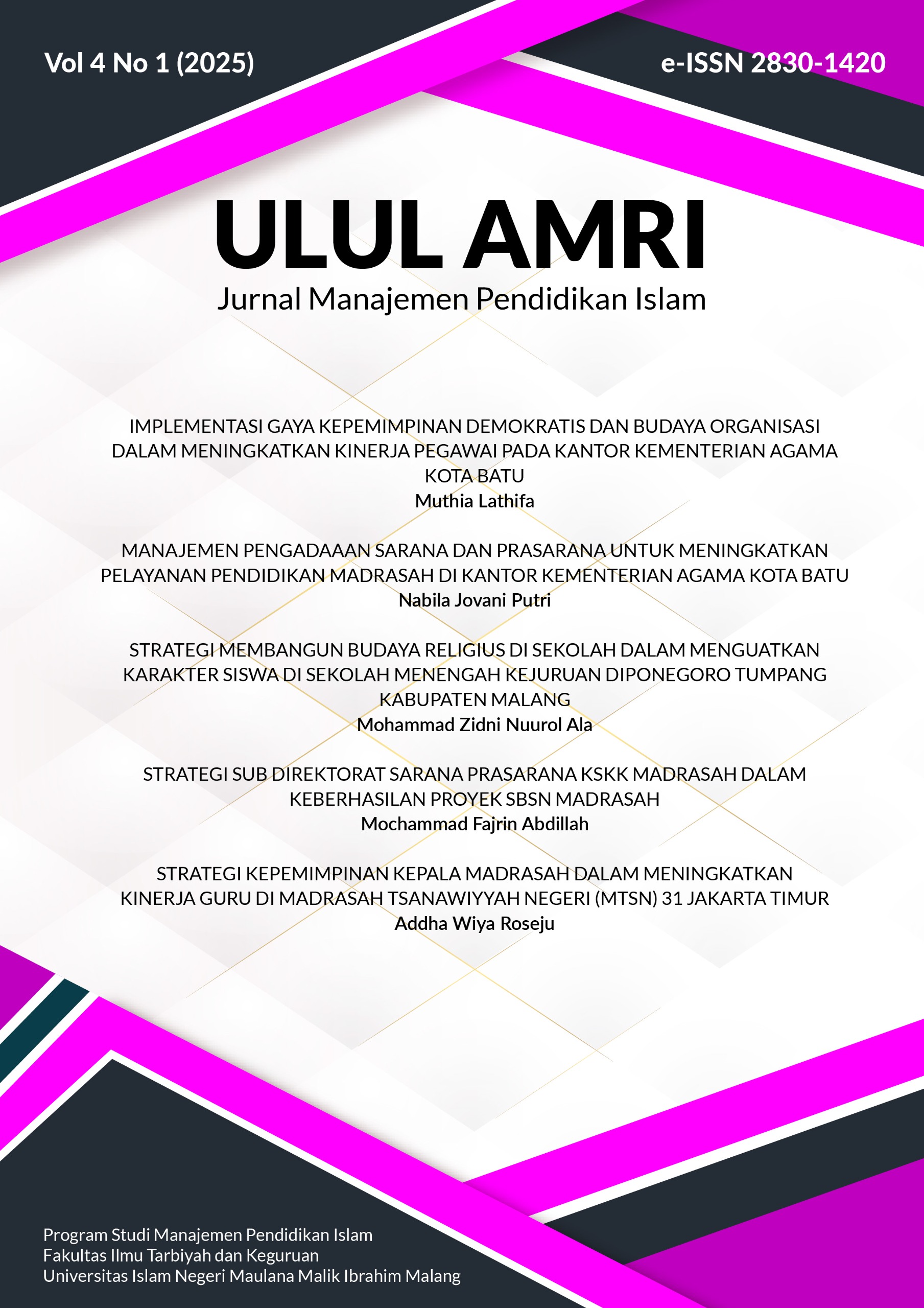
IMPLEMENTASI GAYA KEPEMIMPINAN DEMOKRATIS DAN BUDAYA ORGANISASI DALAM MENINGKATKAN KINERJA PEGAWAI PADA KANTOR KEMENTERIAN AGAMA KOTA BATU
IMPLEMENTASI GAYA KEPEMIMPINAN DEMOKRATIS DAN BUDAYA ORGANISASI DALAM MENINGKATKAN KINERJA PEGAWAI PADA KANTOR KEMENTERIAN AGAMA KOTA BATU
DOI:
https://doi.org/10.18860/uajmpi.v4i1.10903Keywords:
Gaya Kepemimpinan Demokratis, Budaya Organisasi, Kinerja PegawaiAbstract
There are several factors that can affect employee performance, one of which is leadership style and organizational culture. The leadership style of the Head of the Batu City Ministry of Religious Affairs is a democratic leadership style. This leadership style has an important role in creating a conducive and participatory work atmosphere to achieve organizational effectiveness in improving employee performance. Then a strong organizational culture will provide a clear foundation for behavior, values, and norms that must be followed by all members of the organization. This can influence the attitudes and behavior of all components of the organization, thus creating a conducive work environment to achieve optimal performance. This study uses a descriptive qualitative approach with a case study research type. The research data were obtained from interviews, observations and documentation, and analyzed by data condensation, data presentation and drawing conclusions. The results of this study are: 1) The implementation of the democratic leadership style of the Head of the Batu City Ministry of Religious Affairs can be seen from his attitude which is in accordance with the indicators of a democratic leadership style, such as opinions focused on the results of deliberations, tolerance, providing opportunities for employees to develop careers, open to criticism, building a family atmosphere, knowing the strengths and weaknesses of employees, communicating well with employees, and being responsive to situations. 2) The implementation of organizational culture in the Batu City Ministry of Religious Affairs Office shows a positive organizational culture. This can be seen from the implementation of organizational culture indicators consisting of: a) Norms consisting of religious norms, law, politeness and morality. b) Dominant values in the form of the application of the core value of BerAKHLAK, 5 values of the Ministry of Religious Affairs work culture, the value of Faith and Piety, the value of my work is my worship and the value of mutual cooperation. c) The rules that apply in the Batu City Ministry of Religious Affairs Office are all rules or policies that have been regulated by the state. d) The organizational climate of the Batu City Ministry of Religious Affairs shows a cool and harmonious working atmosphere. Employees always implement togetherness and mutual cooperation and help each other. This small work environment also causes work to pile up in several employees.
Downloads
References
Akhmad H. (2012). “Implementasi Pendidikan Multikultural dalam Praksisi Pendidikan di Indonesia". Jurnal Pembangunan Pendidikan. Vol. 2. hal. 72.
Asrul, Muhammadiah dan Mustari. (2021). "Pengruh Budaya Organisasi Terhadap Kinerja Pegawai Pada Kantor Badan Perencanaan Pembangunan Daerah Kabupaten Kolaka Utara". Kajian Ilmiah Mahasiswa Administrasi Publik (KIMAP). Vol. 2, No. 6.
Badu, Syamsu Q and Djafri, Novianty. (2017). Kepemimpinan & Perilaku Organisasi. Gorontalo: Ideas Publishing.
Damayanti, Pangkey dan Kolondam. (2016). "Implementasi Sistem Promosi Pejabat Struktural Di Sekretariat Daerah Kota Bitung". Jurnal Administrasi Publik UNSRAT, Vol. 3, No. 42.
Erwin, Anggelia dan Desmon. (2024). "Transformasi Manajemen ASN Pasca Ditetapkan Undang-Undang Nomor 20 Tahun 2023 Tentang Aparatur Sipil Negara", Ensiklopedia of Jurnal. Vol. 6, No. 3.
Ferils and Utami (2022). "Pengaruh Gaya Kepemimpinan Demokratis dan Motivasi Kerja Terhadap Kinerja Pegawai Kantor Kementrian Agama Kabupaten Mamuju”. Jurnal Ilmiah Ilmu Manajemen. Vol. 1, No. 1.
Fitri and Syamsir. (2011). "Pengaruh Gaya Kepemimpinan Terhadap Iklim Kerja Organisasi". Demokrasi. Vol. 10, No. 2.
Heidjrachman and Husnan. (2002). "Manajemen Personalia”. Yogyakarta: BPFE UGM.
Hersey. (2004). "Kunci Sukses Pemimpin Situasional". Jakarta: Delaprasata.
Ilona, Vetty. (2018). "Analisis Kebutuhan Diklat di Pemerintahan". Civil Service, Vol. 12, No. 1.
Istan and Hardinata. (2020). "Gaya Kepemimpinan Demokratis, Disiplin Kerja dan Imbalan Finansial Terhadap Kinerja Pegawai Pada Yayasan Persatuan Perguruan Taman Siswa Curup". Jurnal Ilmiah Ekonomi Bisnis. Vol. 25, No. 1.
Kartono, Kartini. (2017). "Pemimpin Dan Kepemimpinan", Jakarta: PT. Rajagrafindo Persada.
Mangkunegara, Anwar Prabu. (2008). "Manajemen Sumber Daya Manusia Perusahaan". Bandung: PT Remaja Rosdakarya.
Martin, Gerry dan Joseph Pear. (2015). “Modifikasi Perilaku”, Yogyakarta: Pustaka Pelajar.
Nawawi, Hadari. (2018). "Kepemimpinan Mengefektifkan Organisasi". Yogyakarta: Gajah Mada University Press.
Pariakan et al. (2023). "Pengaruh Beban Kerja Pegawai , Motivasi Kerja dan Kompetensi Pegawai Terhadap Prestasi Kerja Pegawai (Suatu Kajian Studi Literatur Manajemen Sumber Daya Manusia)". Jurnal Ekonomi Manajemen Sistem Informasi. Vol. 3, No. 3.
Pasaribu, Sjahril Effendy. (2015). "Budaya Organisasi Budaya Perusahaan Budaya Organisasi", Medan: USU Pres.
Peny. (2023). “Pengaruh Kepemimpinan Demokratis Dan Budaya Organisasi Terhadap Kinerja Pegawai Di Kantor Dinas Pariwisata Kabupaten Alor (Studi Kasus Pada Masa Pandemik Covid-19 Tahun 2020-2021)". Jurnal Ilmiah Wahana Pendidikan, 9(8), hal. 794.
Peraturan Badan Kepegawaian Negara RI No. 5 Tahun 2019 Tentang Tata Cara Pelaksanaan Mutasi. 2019. Jakarta.
Robbins, Stephen P. (2002). "Perilaku Organisasi: Konsep, Kontrovensi, Dan Aplikasi", Jakarta: Erlangga.
Robbins, Stephen P. (2002). "Prinsip-Prinsip Perilaku Organisasi", Jakarta: Erlangga.
Rosmi, Nurmalia dan Astari. (2021). "Modul Etika & Profesi Kependidikan Berbasis Case Method". Jakarta: UM Jakarta Press.
Saputra, Rusdinal dan Gistituati. (2022). "Kepemimpinan Demokratis Kepala Sekolah di Sekolah Menengah Kejuruan". Edukatif : Jurnal Ilmu Pendidikan. Vol. 5, No. 1.
Setiawan, Guntur. (2004). "Implementasi dalam Birokrasi Pembangunan". Jakarta: Balai Pustaka.
Slamet et al. (2024). "Nilai dan Norma Sebagai Dasar Membangun Karakter", Jurnal Abdimas, Vol. 10, No. 1.
Suryana, Toto. (2011). “Konsep dan Aktualisasi Kerukunan", Jurnal Pendidikan Agama Islam, Vol. 9, No. 2.
Susanty, Etty. (2013). "Iklim Organisasi: Manfaatnya Bagi Organisasi". Semnas Fekon: Optimisme Ekonomi Indonesia, Vol. 1, No. 2.
Sutikno, Sobri. (2014). "Pemimpin & Kepemimpinan", Lombok: Holistica, hal. 15.
Sutrisno, Edy. (2014). "Manajemen Sumber Daya Manusia", Jakarta: Kencana Predana Media Group.
Terry, George R. and Rue, Leslie W. (2010). "Dasar-Dasar Manajemen". Jakarta: PT Bumi Aksara.