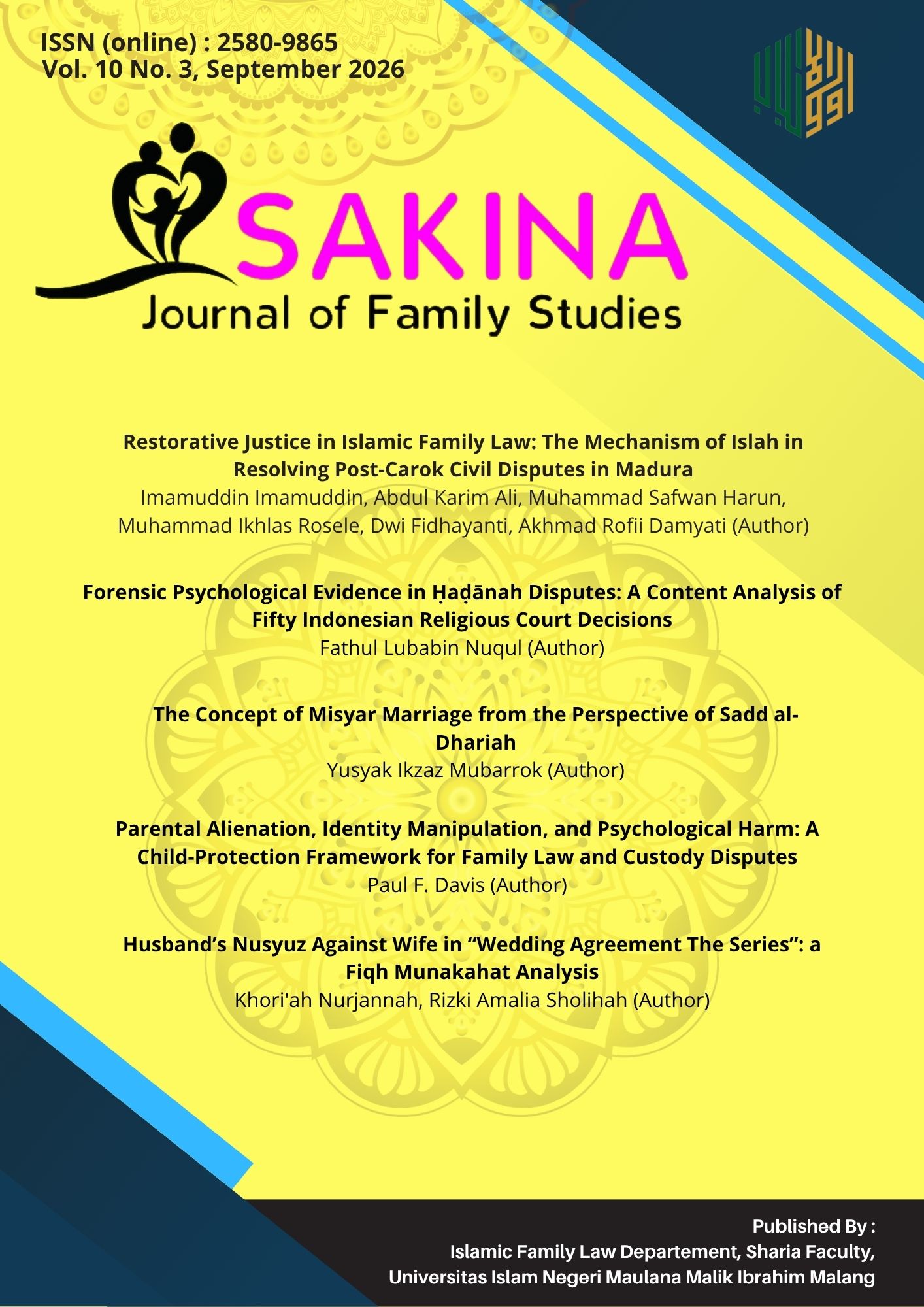
Forensic Psychological Evidence in Ḥaḍānah Disputes: A Content Analysis of Fifty Indonesian Religious Court Decisions
DOI:
https://doi.org/10.18860/jfs.v10i3.25303Keywords:
Hak asuh anak; Psikologi forensik; Hukum keluarga Islam; Hadhanah; Pengadilan Agama Indonesia.Abstract
This study analyzes how forensic psychological evidence is used in child custody (ḥaḍānah) decisions of Indonesian Religious Courts. Prior research suggests judicial inconsistency in accommodating psychological evidence, but no systematic mapping of the pattern exists. This study employs quantitative content analysis of 50 Religious Court and Sharia Court decisions issued between 2015 and 2026, retrieved from the Supreme Court Decision Directory and coded for party characteristics, outcomes, the presence and judicial treatment of psychological evidence, and the ratio decidendi. The findings show that custody was awarded to mothers in 58% of cases, consistent with Article 105 of the Compilation of Islamic Law (KHI). Psychological evidence was absent in 86% of cases, and 92% of decisions contained no explicit assessment of its evidentiary weight. In the five cases where psychological evidence appeared, judges used it to prove grounds for divorce, treated it as supporting confirmation, or explicitly set it aside; none constituted a parenting-fitness evaluation meeting forensic standard. The study recommends custody-evaluation guidelines, forensic-literacy training for judges, and a mechanism for appointing psychological experts in ḥaḍānah proceedings.
Downloads
References
American Psychological Association. “Guidelines for Child Custody Evaluations in Family Law Proceedings.” American Psychologist 65, no. 9 (2010): 863–867. https://doi.org/10.1037/a0021250.
Arbillah, A., Z. Makkawaru, and K. Kamsilaniah. “Analisis Hukum Pelaksanaan Hak Asuh Anak setelah Putusan Pengadilan Agama Kelas IA Makassar.” Indonesian Journal of Legality of Law 5, no. 2 (2023): 206–211. https://doi.org/10.35965/ijlf.v5i2.2608.
Bow, J. N., and F. A. Quinnell. “A Critical Review of Child Custody Evaluation Reports.” Family Court Review 40, no. 2 (2002): 164–176. https://doi.org/10.1111/j.174-1617.2002.tb00827.x.
Brandt, S. “The Myth of Gender Neutrality in Family Court: A Clinician’s Perspective on Determinations of ‘the Best Interest of the Child.’” International Journal of Applied Psychoanalytic Studies 20, no. 3 (2023): 403–434. https://doi.org/10.1002/aps.1838.
Ceci, Stephen J., and Maggie Bruck. “Suggestibility of the Child Witness: A Historical Review and Synthesis.” Psychological Bulletin 113, no. 3 (1993): 403–439. https://doi.org/10.1037/0033-2909.113.3.403.
Chung, D. S., D. S. Moon, M. H. Lee, and Y. S. Kwack. “Custody Evaluation Process and Report Writing.” Journal of the Korean Academy of Child and Adolescent Psychiatry 31, no. 2 (2020): 58–65. https://doi.org/10.5765/jkacap.200006.
Cyr, C., K. Dubois-Comtois, D. Paquette, L. Lopez, and M. Bigras. “An Attachment-Based Parental Capacity Assessment to Orient Decision-Making in Child Protection Cases: A Randomized Control Trial.” Child Maltreatment 27, no. 1 (2022): 66–77. https://doi.org/10.1177/1077559520967995.
Davis, L. S., and P. M. Stahl. “Identifying and Managing Evaluator Biases in Parenting Plan Evaluations.” Family Court Review 61, no. 4 (2023): 762–781. https://doi.org/10.1111/fcre.12743.
de Ruiter, C., and N. Kaser-Boyd. Forensic Psychological Assessment in Practice. New York: Routledge, 2015.
Eka, and L. Diah Sugiarti. “Pemberian Hak Asuh Anak kepada Ayah Pasca Perceraian dalam Putusan Pengadilan Agama Kuningan No. 2037/Pdt.G/2028/PA.Kng.” Al Mashalih: Journal of Islamic Law 5, no. 1 (2024): 17–34. https://doi.org/10.59270/mashalih.v5i01.239.
Fariña, F., L. Redondo, D. Seijo, M. Novo, and R. Arce. “A Meta-Analytic Review of the MMPI Validity Scales and Indexes to Detect Defensiveness in Custody Evaluations.” International Journal of Clinical and Health Psychology 17, no. 2 (2017): 128–138. https://doi.org/10.1016/j.ijchp.2017.02.002.
Himpunan Psikologi Indonesia. Kode Etik Psikologi Indonesia. Jakarta: Pengurus Pusat HIMPSI, 2010.
Jezierski, K., and M. Kujawa. “Keeping Both Parents’ Bond with Their Child in Separation Situation: Considerations in the Context of Forensic-Psychological Diagnosis.” Educational Psychology 62, no. 20 (2021): 57–74. https://doi.org/10.5604/01.3001.0015.3822.
Kadarisman, A., A. Fedro, and Z. Arifin. “Best Interest of the Child in Islamic Family Law: Integrating Maqāṣid al-Sharīʿah and Double Movement Theory in Ḥaḍānah Cases.” Jurnal Al-Dustur 8, no. 2 (2025): 155–174. https://doi.org/10.30863/aldustur.v8i2.10459.
Kruk, E., and J. J. Harman. “Countering Arguments against Parental Alienation as a Form of Family Violence and Child Abuse.” The American Journal of Family Therapy 53, no. 2 (2025): 117–146. https://doi.org/10.1080/01926187.2024.2396279.
Lily, A., W. Waspada, and J. Juliati. “Tinjauan Yuridis terhadap Hak Asuh Anak Berdasarkan Putusan No. 359/Pdt.G/2022/PA.Mks.” Clavia 22, no. 1 (2024): 39–50. https://doi.org/10.56326/clavia.v22i1.4097.
Moon, D. S., M. H. Lee, D. S. Chung, and Y. S. Kwack. “Custody Evaluation in High-Conflict Situations Focused on Domestic Violence and Parental Alienation Syndrome.” Journal of the Korean Academy of Child and Adolescent Psychiatry 31, no. 2 (2020): 66–73. https://doi.org/10.5765/jkacap.200004.
Nambiar, P. P., K. V. Jangam, and S. P. Seshadri. “Psychosocial Perspectives on Child Mental Health in Custody Disputes: A Qualitative Study from India.” Indian Journal of Psychological Medicine 47, no. 4 (2025): 371–380. https://doi.org/10.1177/02537176241254515.
Otto, R. K., J. F. Edens, and E. H. Barcus. “The Use of Psychological Testing in Child Custody Evaluations.” Family Court Review 38, no. 3 (2000): 312–340. https://doi.org/10.1111/j.174-1617.2000.tb00578.x.
Quinnell, F. A., and J. N. Bow. “Psychological Tests Used in Child Custody Evaluations.” Behavioral Sciences & the Law 19, no. 4 (2001): 491–501. https://doi.org/10.1002/bsl.452.
Redondo, L., F. Fariña, D. Seijo, M. Novo, and R. Arce. “A Meta-Analytical Review of the Responses in the MMPI-2/MMPI-2-RF Clinical and Restructured Scales of Parents in Child Custody Dispute.” Anales de Psicología 35, no. 1 (2018): 156–165. https://doi.org/10.6018/analesps.35.1.338381.
Sani, A. I. “Psychological Expertise in Cases of Interparental Conflict: Recommendations for Practice.” Temas em Psicologia 25, no. 2 (2017): 437–445. https://doi.org/10.9788/TP2017.2-20En.
Simon, R. A., and A. Shienvold. “Parenting Plan Evaluations as Forensic Investigations of Children’s Needs, Parenting Capacities, and Fit.” Family Court Review 61, no. 4 (2023).
Zermatten, Jean. “The Best Interests of the Child Principle: Literal Analysis and Function.” The International Journal of Children’s Rights 18, no. 4 (2010): 483–499. https://doi.org/10.1163/157181810X537391.
Zulfah, Indana, Idha Aprilyana Sembiring, and Rosmalinda. “The Role of Child Psychological Test Results in Custody Decisions in Divorce Cases.” Walisongo Law Review 7, no. 1 (2025): 12–20. https://doi.org/10.21580/walrev.2025.7.1.25593.
Zumbach, J., and R. Volbert. “Forensic Psychological Evaluations in Child Custody and Child Protection Cases.” European Psychologist 26, no. 3 (2021).
Legislation and Regulations
Het Herziene Indonesisch Reglement (HIR) / Reglemen Indonesia yang Diperbaharui.
Presidential Instruction Number 1 of 1991 concerning the Compilation of Islamic Law.
Supreme Court of the Republic of Indonesia. Circular Letter Number 1 of 2017 concerning the Enforcement of the Formulation of the Results of the 2017 Plenary Meeting of the Supreme Court Chambers as Guidelines for the Implementation of Duties for the Courts.
Supreme Court Regulation Number 1 of 2016 concerning Mediation Procedures in Court.
Law of the Republic of Indonesia Number 1 of 1974 concerning Marriage.
Law of the Republic of Indonesia Number 7 of 1989 concerning Religious Courts, as amended by Law Number 3 of 2006 and Law Number 50 of 2009.
Law of the Republic of Indonesia Number 23 of 2004 concerning the Elimination of Domestic Violence.
Law of the Republic of Indonesia Number 35 of 2014 concerning the Amendment to Law Number 23 of 2002 concerning Child Protection.
Court Decisions
Decision of the Religious Court of Ambarawa Number 1652/Pdt.G/2025/PA.Amb.
Decision of the Religious Court of Bantul Number 291/Pdt.G/2025/PA.Btl.
Decision of the Religious Court of Batang Number 925/Pdt.G/2026/PA.Btg.
Decision of the Religious Court of Bengkulu Number 401/Pdt.G/2026/PA.Bn.
Decision of the Religious Court of Cibinong Number 4066/Pdt.G/2025/PA.Cbn.
Decision of the Religious Court of Cirebon Number 218/Pdt.G/2026/PA.CN.
Decision of the Religious Court of Gresik Number 1063/Pdt.G/2026/PA.Gs.
Decision of the Religious Court of Klaten Number 641/Pdt.G/2026/PA.Klt.
Decision of the Religious Court of Nganjuk Number 1125/Pdt.G/2026/PA.NGJ.
Decision of the Religious Court of Nganjuk Number 1315/Pdt.G/2026/PA.NGJ.
Decision of the Religious Court of Palu Number 160/Pdt.G/2026/PA.Pal.
Decision of the Religious Court of Pandeglang Number 535/Pdt.G/2026/PA.Pdlg.
Decision of the Religious Court of Pekanbaru Number 1937/Pdt.G/2025/PA.Pbr.
Decision of the Religious Court of Sukoharjo Number 289/Pdt.G/2026/PA.Skh.
Decision of the Religious Court of Tanjungpinang Number 484/Pdt.G/2025/PA.TPI.
Direktori Putusan Mahkamah Agung Republik Indonesia. https://putusan3.mahkamahagung.go.id/.
Downloads
Published
How to Cite
Issue
Section
License
Copyright (c) 2026 Fathul Lubabin Nuqul (Author)

This work is licensed under a Creative Commons Attribution-ShareAlike 4.0 International License.