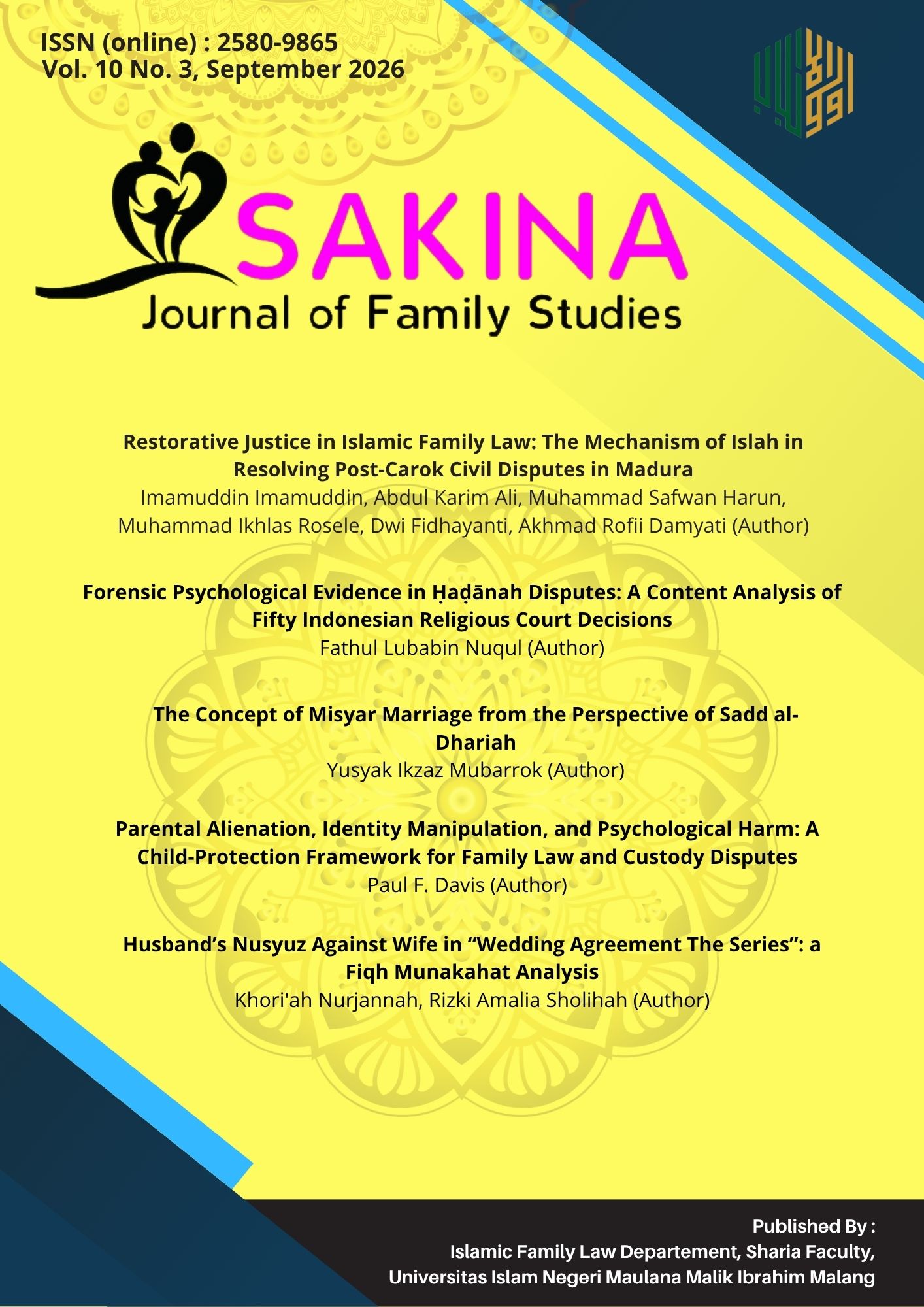
Restorative Justice in Islamic Family Law: The Mechanism of Islah in Resolving Post-Carok Civil Disputes in Madura
DOI:
https://doi.org/10.18860/jfs.v10i3.32913Keywords:
Restorative Justice, Islah, Islamic Family Law, Carok, MaduraAbstract
While the retributive criminal justice system in Indonesia penalizes perpetrators of carok (traditional honor-based duelling in Madura), it consistently overlooks the acute civil-family devastation left in its wake, particularly the collapse of parental obligations regarding child custody (hadhanah), guardianship (perwalian), and maintenance (nafkah) among affected families. This study aims to analyze the concept of islah as an active theoretical doctrine in Islamic jurisprudence and to formulate a structured, civil-family restorative justice model to address these post-violence vulnerabilities. Utilizing a normative-doctrinal legal research methodology, this study integrates statutory and conceptual approaches, relying on primary and secondary legal sources gathered via systematic library research and analyzed through qualitative-descriptive methods. The findings reveal that conventional, court-annexed mediation under Supreme Court Regulation (PERMA) No. 1 of 2016 remains procedurally rigid and unequipped to handle the deep-seated trauma, kinship pressures, and retaliatory dynamics of post-carok disputes. By interpreting the Islamic legal maxim al-sulhu sayyid al-ahkam (reconciliation is the master of all legal judgments) alongside the protective aims of Maqasid al-Shariah (specifically the preservation of lineage and life), this study proposes a specialized "restorative islah" framework. This hybrid model integrates local socio-cultural mediators (such as kiai and customary leaders) within a legally enforceable, court-supervised protocol that guarantees children's best interests, voluntariness, and financial accountability through collective responsibility mechanisms resembling 'aqilah. Ultimately, this study contributes to global legal discourse by demonstrating how pluralistic legal systems can resolve culturally embedded, honor-based family disputes through restorative mechanisms without succumbing to legal formalism or cultural relativism.
Downloads
References
Abdillah, J, T Nurhayati, and M Anwar. “Integrating Islamic Criminal Law Into Indonesia’s New Criminal Code: A Study Of Legal Pluralism And Normative Transformation.” Masalah-Masalah Hukum 55, no. 1 (2026): 1–16. https://doi.org/10.14710/mmh.55.1.2026.1-16.
Ali, Mahrus. “Akomodasi Nilai-Nilai Budaya Masyarakat Madura Mengenai Penyelesaian Carok Dalam Hukum Pidana.” Jurnal Hukum Ius Quia Iustum 17, no. 1 (2010): 85–102. https://doi.org/https://doi.org/10.20885/iustum.vol17.iss1.art4.
Atma, R. “Penyelesaian Sengketa Jalur Mediasi Sebagai Perwujudan Kembalinya Hukum Berbasis Kearifan Lokal.” Jurnal Soumatera Law Review 4, no. 1 (2021): 229–300.
Braithwaite, John. “Restorative Justice and Responsive Regulation Revisited.” Regulation & Governance 16, no. 4 (2022): 987–1001.
Che Adnan, Norfatin Najwa. “Sulh (Resolution) of Family Dispute and Its Application in the Shariah Courts of Malaysia.” Al-Manhaj, n.d.
Darmawan, Joko Budi, Fendy Suhariadi, Suparto Widjojo, Mia Amiati, and Amjad Hamad Abdullah. “Incorporating Islah Principles into Restorative Justice: Bridging Contemporary Legal Practice and Islamic Values.” MILRev: Metro Islamic Law Review 4, no. 1 (2025): 269–94.
Department of Syariah Judiciary Malaysia (Jabatan Kehakiman Syariah Malaysia, JKSM). Practice Direction No. 1 of 2010 (2010).
———. Practice Direction No. 3 of 2002 (2002).
Indonesia, Supreme Court of the Republic of. Regulation of the Supreme Court of the Republic of Indonesia Number 1 of 2016 concerning Mediation Procedures in Court (2016).
Junaedi, Junaedi, Muhammad Afifudin Dimyathi, Aswadi Aswadi, Imam Syafi’i, and Titik Triwulan Tutik. “Restorative Justice in Islamic Criminal Law: A Comparative Study of Diyat and Victim Rights.” Samarah: Jurnal Hukum Keluarga Dan Hukum Islam 8, no. 2 (2024): 847–65.
Kamali, Mohammad Hashim. Shari‘ah Law: An Introduction. Oxford: Oneworld Publications, 2008.
Law, Singapore Academy of. “Therapeutic Justice in the Syariah Court – The Striving for Ihsan.” SAL Practitioner, 2026.
Malaysia. Islamic Family Law (Selangor) Enactment 2003 (2003).
———. Shariah Court Civil Procedure (Selangor) Enactment 2003 (2003).
———. Shariah Court Civil Procedure (Sulh) (Federal Territories) Rules 2004 (2004).
———. Shariah Court Civil Procedure (Sulh) Rules 2001 (2001).
Mien, Ahmad Rifai. Manusia Madura: Perilaku, Etos Kerja, Penampilan, Dan Pandangan Hidupnya. Yogyakarta: Pilar Media, 2007.
Ministry of Culture Singapore, Community and Youth. “Syariah Court’s Marriage Counselling Programme Plays Key Role in Nurturing Strong and Resilient Muslim Families,” 2025.
Nations, United. Convention on the Rights of the Child (1989).
Rohmana, J A. “Mediation in the Islamic Legal Tradition: Tracing the Roots of Restorative Justice in the Practice of Ishlah.” Mimbar Hukum 29, no. 1 (2017): 45–63.
Singapore. Administration of Muslim Law Act (Cap. 3, 2009 Rev. Ed.) (2009).
———. Family Justice Act 2014 (2014).
Sodiqin, Ali. “Restorative Justice in Islamic Law: Integration of Legal, Moral, and Spiritual Aspects.” AHKAM: Jurnal Ilmu Syariah 21, no. 2 (2021): 359–82.
Solikhin, Nanang. “Reconciliation as Sayyid Al-Ahkam: Legal Analysis of Umar Bin Khattab’s Judicial Instructions.” Jurnal Hukum Islam 21, no. 2 (2023): 47–65.
Subrata, T, and H Hikmatullah. “Implementation Of Restorative Justice In Resolving Family Conflicts From The Perspective Of Islamic Family Law.” Multidisciplinary Indonesian Center Journal (MICJO) 3, no. 3 (2026): 2839–43. https://doi.org/10.62567/micjo.v3i3.2452.
Subrata, Tedy, Iin Ratna Sumirat, and Hikmatullah Hikmatullah. “The Urgency of Restorative Justice in Family Conflict Resolution: An Islamic Family Law Perspective.” Jurnal Hukum Islam 22, no. 2 (2024): 116–35.
Sukendar, Sukendar, Muhammad Saifullah, Priyambudi Sulistiyanto, Luthfi Rahman, and A Hasan Asy’Ari Ulamai. “Women’s Access To Justice: Mediation For The Victims of Domestic Violence In Central Java, Indonesia.” Samarah: Jurnal Hukum Keluarga Dan Hukum Islam 7, no. 1 (2023): 602–28.
Syamsuddin, Muhammad. History of Madura. Yogyakarta: Araska, 2019.
Syarof, Bagis, and Faiq Tobroni. “Alasan Harga Diri Pada Praktek Carok (Tinjauan Ham Dan Hukum Islam).” Tahkim 16, no. 1 (2020).
Yangto, Yangto, Sayehu Sayehu, Nafan Tarihoran, and Mustafa Ali Almagdub. “Contested Divorce Cases in Indonesia: Evaluating Mandatory Mediation under PERMA No. 1 of 2016.” Al-Ihkam: Jurnal Hukum Dan Pranata Sosial 17, no. 2 (2022): 253–74.
Downloads
Published
How to Cite
Issue
Section
License
Copyright (c) 2026 Dwi Fidhayanti, imamuddin imamuddin, Abdul Karim Ali, Muhammad Safwan Harun, Muhammad Ikhlas Rosele, Akhmad Rofii Damyati (Author)

This work is licensed under a Creative Commons Attribution-ShareAlike 4.0 International License.